PROXIMA EXPOSICIÓN DE MARCELA JARDÓN
Por: Ángel Alonso
Estamos ante una obra muy táctil, si no fuese por el tema de la conservación -y aquel tabú museístico que concibe la obra de arte como objeto sagrado-, lo primero que debería hacer el espectador sería tocarla, porque puede ser tan importante en ella una rugosidad como lo liso de una textura brillante.
Una obra de arte se construye con materiales (incluso las más conceptuales) y la forma en que se manipulan los mismos es la huella de las decisiones y los pensamientos de un artista. Marcela Jardón (Buenos aires, 1964) es una de aquellas artistas en las que acercarnos a sus procesos nos dará las claves más importantes de su obra.
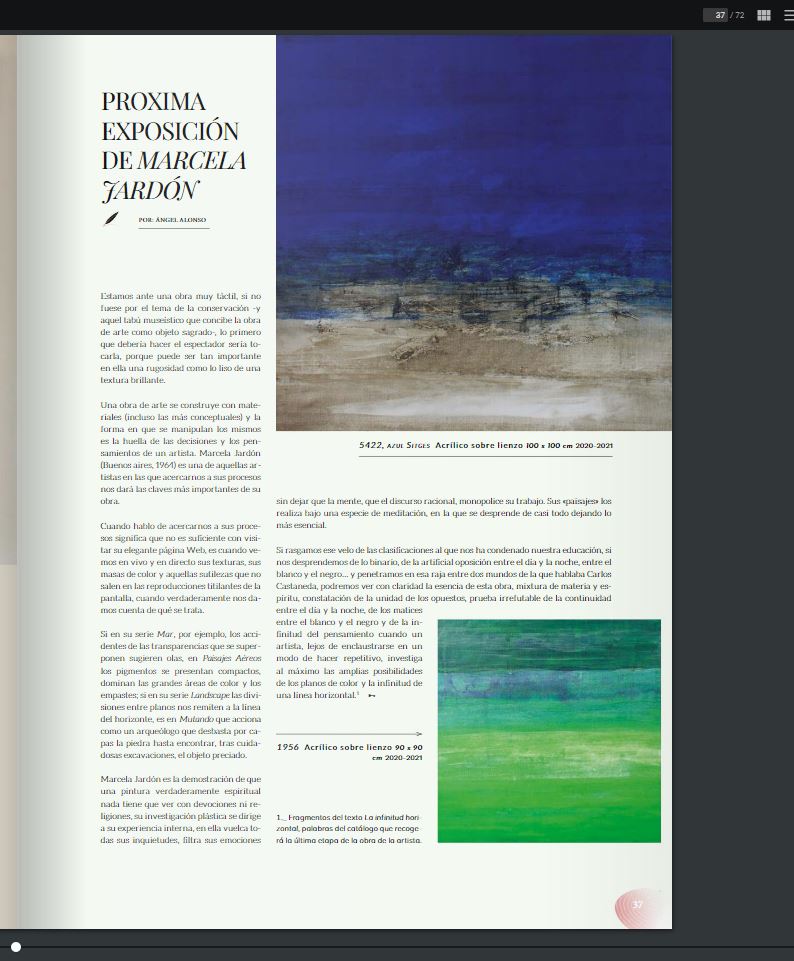
Cuando hablo de acercarnos a sus procesos significa que no es suficiente con visitar su elegante página Web, es cuando vemos en vivo y en directo sus texturas, sus masas de color y aquellas sutilezas que no salen en las reproducciones titilantes de la pantalla, cuando verdaderamente nos damos cuenta de qué se trata.
Si en su serie Mar, por ejemplo, los accidentes de las transparencias que se superponen sugieren olas, en Paisajes Aéreos los pigmentos se presentan compactos, dominan las grandes áreas de color y los empastes; si en su serie Landscape las divisiones entre planos nos remiten a la línea del horizonte, es en Mutando que acciona como un arqueólogo que desbasta por capas la piedra hasta encontrar, tras cuidadosas excavaciones, el objeto preciado.
Marcela Jardón es la demostración de que una pintura verdaderamente espiritual nada tiene que ver con devociones ni religiones, su investigación plástica se dirige a su experiencia interna, en ella vuelca todas sus inquietudes, filtra sus emociones sin dejar que la mente, que el discurso racional, monopolice su trabajo. Sus «paisajes» los realiza bajo una especie de meditación, en la que se desprende de casi todo dejando lo más esencial.
Si rasgamos ese velo de las clasificaciones al que nos ha condenado nuestra educación, si nos desprendemos de lo binario, de la artificial oposición entre el día y la noche, entre el blanco y el negro… y penetramos en esa raja entre dos mundos de la que hablaba Carlos Castaneda, podremos ver con claridad la esencia de esta obra, mixtura de materia y espíritu, constatación de la unidad de los opuestos, prueba irrefutable de la continuidad entre el día y la noche, de los matices entre el blanco y el negro y de la infinitud del pensamiento cuando un artista, lejos de enclaustrarse en un modo de hacer repetitivo, investiga al máximo las amplias posibilidades de los planos de color y la infinitud de una línea horizontal.1
1 Fragmentos del texto La infinitud horizontal, palabras del catálogo que recogerá la última etapa de la obra de la artista.
UPCOMING EXHIBITION BY MARCELA JARDÓN
By: Ángel Alonso
We are faced with a very tactile work. If it weren’t for the issue of conservation—and that museum taboo that conceives of the work of art as a sacred object—the first thing the viewer should do is touch it, because a roughness can be just as important as the smoothness of a glossy texture.
A work of art is constructed with materials (even the most conceptual ones), and the way in which these materials are manipulated is the imprint of an artist’s decisions and thoughts. Marcela Jardón (Buenos Aires, 1964) is one of those artists whose processes, when examined closely, will give us the most important keys to understanding her work.
When I speak of examining her processes, I mean that it is not enough to visit her elegant website. It is when we see her textures, her masses of color, and those subtleties that don’t appear in the flickering reproductions on the screen, that we truly understand what it is all about.
If in her series *Mar* (Sea), for example, the overlapping transparencies suggest waves, in *Paisajes Aéreos* (Aerial Landscapes) the pigments are compact, dominated by large areas of color and impasto; if in her series *Landscape* the divisions between planes evoke the horizon line, it is in *Mutando* (Mutating) that she acts like an archaeologist chipping away at the stone layer by layer until, after careful excavation, she finds the precious object.
Marcela Jardón is proof that truly spiritual painting has nothing to do with devotions or religions. Her artistic exploration is directed toward her inner experience, into which she pours all her anxieties, filtering her emotions without letting the mind, or rational discourse, monopolize her work. She creates her «landscapes» in a kind of meditation, in which she detaches herself from almost everything, leaving only the essential.
If we tear away the veil of classifications to which our education has condemned us, if we rid ourselves of the binary, of the artificial opposition between day and night, between black and white… and penetrate that fissure between two worlds of which Carlos Castaneda spoke, we will be able to clearly see the essence of this work: a mixture of matter and spirit, a confirmation of the unity of opposites, irrefutable proof of the continuity between day and night, of the nuances between black and white, and of the infinity of thought when an artist, far from confining themselves to a repetitive mode of working, fully explores the vast possibilities of planes of color and the infinity of a horizontal line.<sup>1</sup>
Excerpts from the text «Horizontal Infinity,» from the catalogue that will showcase the artist’s latest work.